“No More Rice Straw Burning – We Can Do It” Stop Agricultural Burning Before It’s Too Late
Last updated: 6 Jul 2026
678 Views
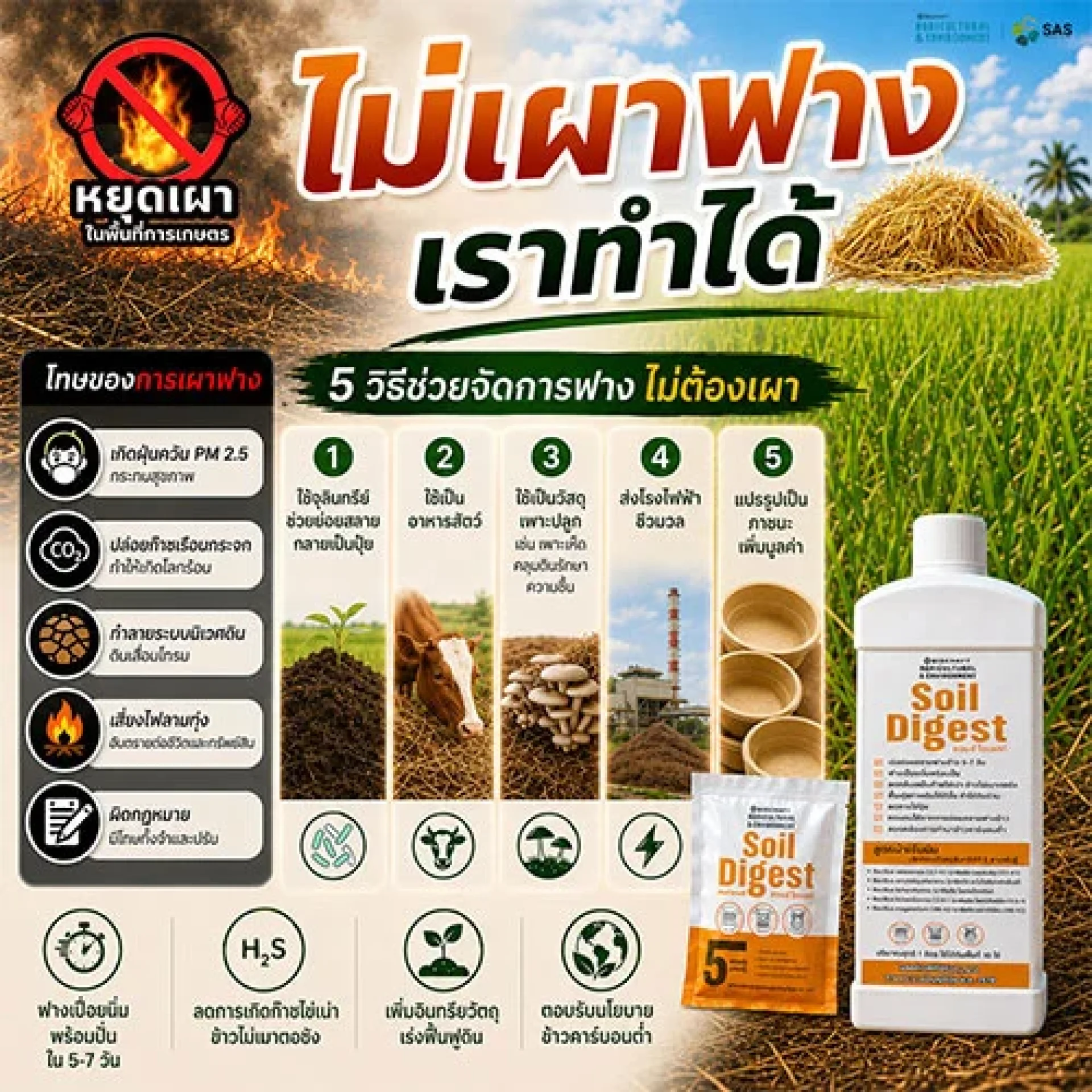
“No More Rice Straw Burning – We Can Do It”
Stop Agricultural Burning Before It’s Too Late
Every year after harvest season, many farmers still choose to burn rice straw as a quick way to clear their fields. However, behind this convenience lies a range of serious consequences affecting human health, the environment, and farmers themselves.
The Harmful Effects of Rice Straw Burning
PM2.5 Air Pollution
Burning rice straw releases fine particulate matter (PM2.5), which can negatively impact respiratory health for people living both nearby and in surrounding communities.
Greenhouse Gas Emissions
Open-field burning contributes significantly to greenhouse gas emissions, accelerating global warming and climate change.
Soil Degradation
The heat from burning destroys beneficial microorganisms and organic matter in the soil, reducing long-term soil fertility and productivity.
Risk of Uncontrolled Fires
Agricultural fires can easily spread beyond intended areas, threatening lives, crops, and property.
Legal Consequences
Open burning may violate environmental regulations and can result in fines or legal penalties, depending on local laws and enforcement policies.
How Can Farmers Manage Rice Straw Without Burning?
There are several practical ways to utilize rice straw instead of burning it:
Use microbial solutions to decompose straw into organic fertilizer and improve soil quality.
Process it into animal feed for livestock farming.
Use it as a growing medium, such as mushroom cultivation or soil mulching to retain moisture.
Supply it as biomass fuel for renewable energy production.
Convert it into value-added products, including biodegradable containers and other eco-friendly materials.
Among these options, one of the easiest and most effective solutions is using beneficial microorganisms to convert rice straw into organic matter that enriches the soil while reducing waste.
Soil Digest: The Smart Solution for Rice Straw Decomposition
Soil Digest is a concentrated microbial inoculant formulated with five high-performance bacterial strains:
Bacillus velezensis
Bacillus amyloliquefaciens
Bacillus licheniformis
Bacillus licheniformis (additional strain)
Bacillus megaterium
The product is specifically developed to accelerate the decomposition of rice stubble and straw, helping farmers quickly prepare their fields for the next cultivation cycle.
Key Benefits of Soil Digest
✅ Rapid straw decomposition in 5–7 days
Rice straw becomes soft and easy to incorporate into the soil.
✅ Converts straw into valuable organic matter
Enhances soil fertility and increases soil organic content.
✅ Reduces unpleasant hydrogen sulfide (H₂S) odors
Helps minimize odor caused by accumulated and decaying crop residues.
✅ Restores soil structure
Improves soil aeration and tilth, creating better conditions for future crops.
✅ Reduces tillage requirements
Helps lower labor costs, fuel consumption, and field preparation expenses.
✅ Supports Low-Carbon Rice Farming
Reduces open-field burning and helps decrease greenhouse gas emissions.
✅ Economical Application
One liter can be applied to approximately 10 rai (about 1.6 hectares) of agricultural land.
Turn Straw Into Value, Not Toxic Smoke
Eliminating rice straw burning does not have to increase the burden on farmers. Instead, it is an opportunity to transform agricultural residue into a valuable resource that enriches the soil and supports sustainable farming.
With Soil Digest, farmers can enjoy healthier soil, lower production costs, and cleaner air for their communities.
Stop Burning Rice Straw – Start Today with Soil Digest
Watch field results on YouTube:
https://www.youtube.com/@soildigestbysas
Product information:
https://www.sasgroup.co/soil-digest
For orders and inquiries:
Inbox our Facebook page or call 099-116-1943
Stop Agricultural Burning Before It’s Too Late
Every year after harvest season, many farmers still choose to burn rice straw as a quick way to clear their fields. However, behind this convenience lies a range of serious consequences affecting human health, the environment, and farmers themselves.
The Harmful Effects of Rice Straw Burning
PM2.5 Air Pollution
Burning rice straw releases fine particulate matter (PM2.5), which can negatively impact respiratory health for people living both nearby and in surrounding communities.
Greenhouse Gas Emissions
Open-field burning contributes significantly to greenhouse gas emissions, accelerating global warming and climate change.
Soil Degradation
The heat from burning destroys beneficial microorganisms and organic matter in the soil, reducing long-term soil fertility and productivity.
Risk of Uncontrolled Fires
Agricultural fires can easily spread beyond intended areas, threatening lives, crops, and property.
Legal Consequences
Open burning may violate environmental regulations and can result in fines or legal penalties, depending on local laws and enforcement policies.
How Can Farmers Manage Rice Straw Without Burning?
There are several practical ways to utilize rice straw instead of burning it:
Use microbial solutions to decompose straw into organic fertilizer and improve soil quality.
Process it into animal feed for livestock farming.
Use it as a growing medium, such as mushroom cultivation or soil mulching to retain moisture.
Supply it as biomass fuel for renewable energy production.
Convert it into value-added products, including biodegradable containers and other eco-friendly materials.
Among these options, one of the easiest and most effective solutions is using beneficial microorganisms to convert rice straw into organic matter that enriches the soil while reducing waste.
Soil Digest: The Smart Solution for Rice Straw Decomposition
Soil Digest is a concentrated microbial inoculant formulated with five high-performance bacterial strains:
Bacillus velezensis
Bacillus amyloliquefaciens
Bacillus licheniformis
Bacillus licheniformis (additional strain)
Bacillus megaterium
The product is specifically developed to accelerate the decomposition of rice stubble and straw, helping farmers quickly prepare their fields for the next cultivation cycle.
Key Benefits of Soil Digest
✅ Rapid straw decomposition in 5–7 days
Rice straw becomes soft and easy to incorporate into the soil.
✅ Converts straw into valuable organic matter
Enhances soil fertility and increases soil organic content.
✅ Reduces unpleasant hydrogen sulfide (H₂S) odors
Helps minimize odor caused by accumulated and decaying crop residues.
✅ Restores soil structure
Improves soil aeration and tilth, creating better conditions for future crops.
✅ Reduces tillage requirements
Helps lower labor costs, fuel consumption, and field preparation expenses.
✅ Supports Low-Carbon Rice Farming
Reduces open-field burning and helps decrease greenhouse gas emissions.
✅ Economical Application
One liter can be applied to approximately 10 rai (about 1.6 hectares) of agricultural land.
Turn Straw Into Value, Not Toxic Smoke
Eliminating rice straw burning does not have to increase the burden on farmers. Instead, it is an opportunity to transform agricultural residue into a valuable resource that enriches the soil and supports sustainable farming.
With Soil Digest, farmers can enjoy healthier soil, lower production costs, and cleaner air for their communities.
Stop Burning Rice Straw – Start Today with Soil Digest
Watch field results on YouTube:
https://www.youtube.com/@soildigestbysas
Product information:
https://www.sasgroup.co/soil-digest
For orders and inquiries:
Inbox our Facebook page or call 099-116-1943
Related Content

Working-age adults today face constant pressure—tight deadlines, fierce competition, financial struggles, and relationship challenges.
23 Sept 2025

During festivals or social gatherings, many people often have a glass in one hand and a plate of snacks in front of them. Drinking alcohol has become a normal part of socializing. However, what many overlook are the hidden health impacts from both the drinks and the snacks beside the glasses.
19 May 2025

COVID-19, caused by the SARS-CoV-2 virus, remains a health threat that should not be overlooked, especially during the rainy season when the virus spreads more easily. The Department of Disease Control reports that from the beginning of 2025 until May 8th, there have been a total of 41,197 cases and 15 deaths. Data indicate that the most affected group is children aged 0–5 years, and the majority of fatalities are among the elderly.
26 May 2025
